US Home Insurers Post First Underwriting Profit Since 2019
Home insurers recorded a $16.5 billion underwriting profit in 2025 as better risk pricing, calmer hurricane activity and reserve changes lifted results.

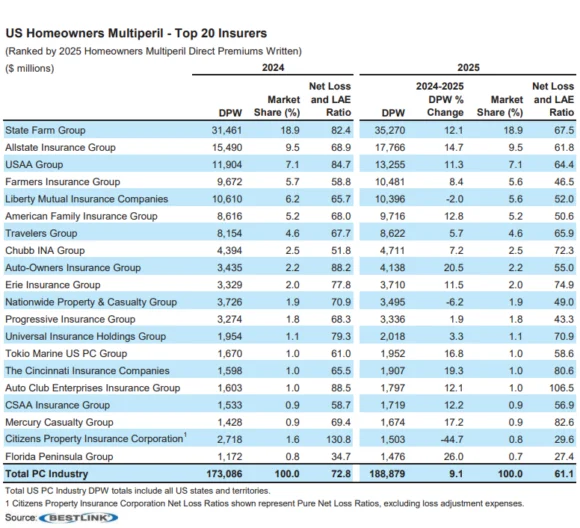
U.S. homeowners insurers returned to underwriting profit in 2025 for the first time since 2019, a sharp reversal after years of losses. AM Best reported a $16.5 billion gain for the line, compared with a $1.3 billion loss in 2024. The result points to stronger financial performance, though it reflects several factors that may not recur in the same way each year.

Seven of the eight years from 2017 through 2024 brought underwriting losses for homeowners insurers. The recent improvement followed sustained premium increases intended to bring prices closer to the risks insurers were covering. AM Best said insurers are “doing a much better job of matching rate to risk.” That change in pricing, paired with a relatively calm 2025 hurricane season, helped produce the stronger result.

Combined ratio drops to 84.5
The sector’s combined ratio fell to 84.5 in 2025, down from 90.7 in 2024 and 99.5 in 2023. This measure compares claims and operating expenses with premium income: a lower ratio generally indicates that an insurer kept more of its premium after those costs. The 2025 figure shows a considerable improvement across the segment, although it doesn’t explain how results varied among individual companies or locations.

Pricing was part of a broader effort to improve underwriting performance. Insurers also invested in underwriting, claims handling, loss control and operating efficiency, according to Maurice Thomas, AM Best senior financial analyst. Those efforts can affect how companies assess risk, manage claims and control expenses. Their contribution sits alongside the effects of premium changes and catastrophe experience, rather than replacing them.

Rate increase filings slowed during the second half of 2025, AM Best said, and that pattern continued into 2026. Slower filings suggest a shift in the pace of price changes, but don’t establish that premiums are falling for every policyholder. Homeowners’ renewal costs can still differ by insurer, property and location, and the report’s sector result doesn’t determine the price any one household will pay.

Reinsurance and data also supported results
Home insurers also benefited from softer pricing in the reinsurance market. Reinsurance is coverage insurers buy to help absorb losses, including large claims or accumulations of claims from severe events. When that protection becomes less costly, it can ease one expense for insurers. The effect on an individual insurer depends on its reinsurance arrangements and the risks it covers.

Better use of data, analytics and modeling also contributed to the segment’s progress. These tools can help insurers estimate risk and make underwriting decisions. Their value depends on how companies apply them and how well their assumptions reflect actual losses. AM Best described the combination of improved tools and operational investments as part of the work behind stronger results.
Reserve releases added to the gain
Favorable loss-reserve development also lifted results in recent years. Insurers set aside reserves for claims they expect to pay; later, they may adjust those estimates as claims develop and more information becomes available. When earlier reserves prove larger than needed, reducing them can improve a period’s reported results. AM Best said that this contribution isn’t typically built into an underwriting profit scenario, so it merits attention alongside the operating improvement.
Five insurance groups—USAA, American Family, Liberty Mutual, Chubb and RenaissanceRe US—accounted for 47% of the $4.1 billion in favorable development in 2025, according to AM Best. That concentration shows how reserve changes at a handful of groups contributed substantially to the total. It also means the sector-wide figure combines ongoing underwriting performance with adjustments linked to claims from earlier periods.
AM Best also pointed to changes in Florida, where reduced property-related lawsuits led insurers to reassess reserves and take some down. Florida is the country’s second-largest insurance market, so those reserve actions had an outsized effect on national underwriting results, the firm said. The impact illustrates how developments in a large state can influence a national segment’s reported numbers even when the underlying changes occur within particular markets.
For policyholders and industry watchers, the 2025 figures mark a meaningful turnaround after a long stretch of underwriting losses. The results reflect pricing, claims and expense management, reinsurance costs, catastrophe experience and reserve adjustments together. The next signal to watch is whether the improved ratio holds as rate changes slow and insurers report results from future hurricane seasons.


