Commercial Property Rates Fall 14.5% as Buyers Find More Capacity
Large property rates fell faster year over year in Q2 2026. Cyber and casualty markets show a more mixed picture for buyers.
Commercial property buyers entered the second quarter of 2026 with more room to negotiate: rates for large and complex risks in WTW’s portfolio fell 14.5%, compared with an 8.4% decline in the same quarter a year earlier. For shared and layered programs involving five or more carriers, the reported reduction was about 23.4%. The figures point to a market with more capacity and stronger pricing competition, though results will vary by account and program structure.

The data comes from the fall 2026 edition of Willis, a WTW business, and its Insurance Marketplace Realities report. It examines dozens of commercial insurance lines in North America. The property rate figures describe changes in premiums, rather than a uniform reduction for every buyer. A company’s renewal terms can still depend on its exposures, loss experience, coverage needs and the number of insurers willing to participate.

More competition in complex property placements
The largest reported reduction applied to shared and layered placements with at least five carriers. In these programs, insurers each take a portion of the overall risk, so a buyer may be able to assemble coverage from several markets. A reduction of about 23.4% suggests that competition for these placements was especially strong during Q2 2026.

WTW also described treaty reinsurance renewals as softening. Reinsurance is coverage that insurers buy to help manage their own losses. When reinsurance conditions ease, insurers may have more scope to offer primary coverage, and WTW linked the softer renewals to abundant primary capacity. That connection can support competition, although it does not guarantee that every insurer will expand its offer or that every policyholder will see a similar price change.

The report put catastrophe losses for the first half of 2026 at $42 billion, the lowest first-half total since 2020. That figure provides context for the property market, but it does not by itself explain the rate movement for any individual account. Insurers still assess the particular property and its risk characteristics when setting terms.

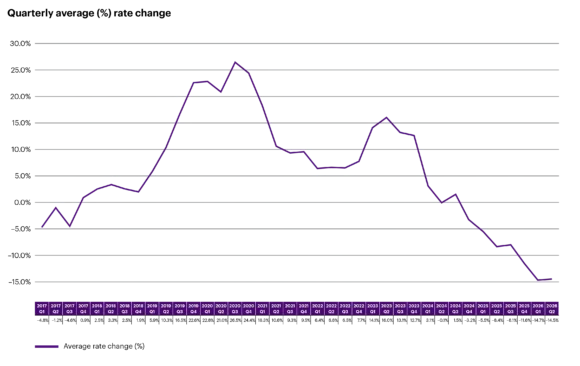
WTW said the market’s direction has shifted from the difficult stretch spanning Q1 2018 through Q1 2024. Its chart tracks quarterly average commercial property rate changes from 2017 through Q2 2026, including a peak increase of 26.5% in Q3 2020 and the 14.5% decrease in Q2 2026. The longer view puts the latest decline in perspective: conditions have turned from sharp increases to sustained decreases, rather than changing in a single renewal cycle.
Cyber and casualty renewals remain distinct
Cyber pricing was more mixed. WTW said rates were holding within a range from a 5% decrease to a 5% increase. The report described market conditions as favorable to buyers despite rising risks, and advised clients to consider putting insurance savings toward higher limits. That is a planning option identified by the broker, not a promise that additional limits will be available on the same terms.
Ransomware remained a leading source of cyber losses, while artificial intelligence was adding risk as businesses use it to improve efficiency and speed up decisions. Those developments make cyber placements a two-sided discussion: buyers may encounter competitive pricing, but they still need to consider how their exposures and coverage needs are changing. WTW said buyers may have opportunities to improve their insurance programs through 2026, while signs of rate moderation are appearing among some cyber insurers and business classes.
Casualty rates were also rising more slowly, according to the report, but the market remained shaped by severity trends, social inflation and litigation risk. Willis said those pressures continued to support disciplined underwriting, higher retentions and strategic program design. At the same time, competition and available capacity were improving. Slower increases therefore signal a change in pace, not an end to underwriting scrutiny or a broad promise of lower costs.
What buyers can take to renewal discussions
For businesses preparing a renewal, the report’s clearest practical signal is that market conditions differ by line and placement. Large property risks and heavily layered programs saw notable decreases, while cyber rates stayed within a narrow band and casualty increases moderated. A buyer should read any indication against its own proposed terms: premium, limits, retentions, exclusions and the insurers participating in the program.
WTW described signs of greater stability as rate increases slow and predictability improves, while also emphasizing that underwriting discipline and selective capacity deployment remain features of the market. That combination means the most useful renewal conversation is likely to examine the full coverage structure alongside the price. The Q2 figures show where competition strengthened; the account’s actual renewal offer will show how much of that shift reaches the buyer.


