AM Best Reports Fewer Downgrades for U.S. P/C Insurers in H1 2026
Downgrades fell to 3.8% of rating actions as upgrades rose, though commercial casualty and auto insurers still faced operating pressure.
U.S. property and casualty insurers recorded fewer credit rating downgrades and more upgrades in the first half of 2026, according to AM Best. The shift points to stronger results across much of the sector, while persistent pressure in commercial casualty and commercial auto shows that improvement has not reached every line equally.

Downgrades made up 3.8% of AM Best’s rating actions for the period, down from 6.1% in the first half of 2025. Upgrades rose to 8.2% of actions, compared with 5.5% a year earlier. The figures describe the share of rating actions, rather than the proportion of insurers that received a particular rating change.

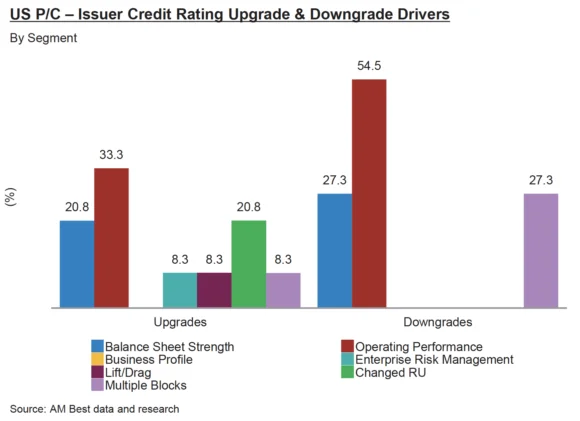
Operating results were a major factor in both directions. More than half of downgrades reflected weak operating performance, as some carriers struggled to control losses. Adverse reserve development, which can worsen balance sheet measures when past claim estimates prove insufficient, drove a further 27.3% of downgrades. Other downgrades involved changes across multiple business blocks, including balance sheet strength.

Commercial casualty and commercial auto carriers accounted for most of the downgrades in 2026. The concentration suggests that results in these lines remain a key pressure point, even as the broader rating picture improved. Social inflation was among the conditions commercial insurers had to manage, according to AM Best.

On the upgrade side, better operating performance accounted for about one-third of the increases. AM Best pointed to rate increases that had flowed through insurers’ results, continued underwriting discipline and stronger investment returns, despite volatility in equity markets. Pricing gains can take time to affect reported results as policies renew and premium is earned; the report links that process with improved performance during the period.

Personal and commercial lines show different strengths
AM Best described the claims environment as relatively benign so far in 2026, while noting that insurers still faced inflation and higher reinsurance costs. Those conditions affect how much claims cost and how much carriers pay to transfer some risk to reinsurers. Helen Andersen, an industry analyst at AM Best, said personal lines insurers were better positioned to handle these pressures than in recent years as rate increases earned through the segment.
For commercial lines, AM Best cited solid results supported by higher investment yields and overall investment performance. The segment’s results came despite the challenge of social inflation, which can increase claim costs over time. The report also pointed to sustained pricing strength and disciplined risk management as supports for its stable outlook on commercial lines.
As of June 30, 2026, 82.3% of commercial writers had a stable outlook, making stable assessments the clear majority in the largest segment. Positive outlooks declined by one rating unit, while negative outlooks increased by 0.6%. The share of “under reviews” rose by 0.8%, according to the report. Those outlook categories offer a view of the direction AM Best sees in insurers’ credit standing; they are distinct from a downgrade or upgrade already recorded.
AM Best also maintained a stable outlook for personal lines in December 2025. Its rationale included improved underwriting performance after a strong push for rate adequacy, higher investment yields, moderating reinsurance pricing and availability, and better catastrophe risk management practices.
What the rating mix signals
The change in rating actions suggests that improved performance was broad enough to lift the number of upgrades and reduce downgrades, but the drivers matter as much as the headline shares. Rate increases and investment returns helped some insurers, while loss control and reserve development remained central concerns for those downgraded. A favorable claims period can support results, but it does not remove exposure to inflation, reinsurance costs or line-specific loss trends.
For insurers and market observers, the next useful indicators are whether carriers can sustain underwriting discipline, keep losses within expected levels and maintain the balance sheet strength that ratings depend on. The first-half figures show a better mix of rating actions; the distribution of upgrades, downgrades and outlook changes also makes clear that company performance continues to vary by line and by carrier.


