Hong Kong Fire Inquiry Details Contractor, Consultant and Oversight Failures
A report on the fire that killed 168 people cites unsafe renovation work, ignored resident complaints and gaps in safety oversight.
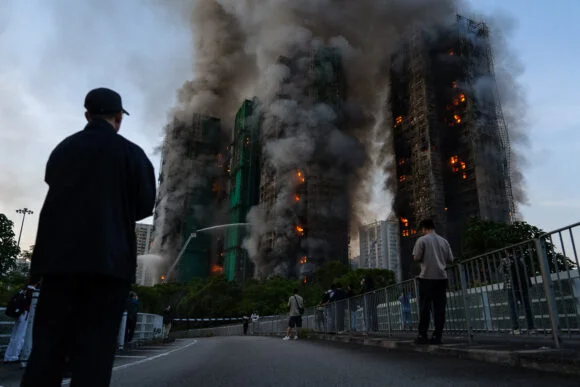
The inquiry into Hong Kong’s deadly Wang Fuk Court fire points to failures across the renovation project and the systems meant to oversee it. A judge-led committee said the contractor and project consultant knew of fire risks, while complaints from residents went unresolved. The blaze killed 168 people last November.
The committee’s report, more than 1,000 pages long, describes conditions that allowed fire to spread rapidly across the residential estate. Its findings center on combustible materials, weak supervision and a lack of clear responsibility for addressing reported hazards. The account suggests that no single missed warning explains the outcome: several problems persisted at once.
Renovation choices compounded the fire risk
Prestige Construction & Engineering Co. Ltd, the main contractor, was responsible for the renovation work. The committee said Prestige failed to maintain proper oversight and cut corners. It also said the company did not effectively enforce a ban on smoking at the work site, despite repeated complaints from residents.
The committee found that Prestige declined a request from the estate’s management committee to carry out the work in phases. As a result, all eight blocks were enclosed at the same time in scaffolding and other materials described as combustible. The report said those conditions contributed to the fire’s rapid spread.

That finding connects project scheduling with the materials surrounding the buildings. Phasing the work could have changed how many blocks were enclosed at once, while the materials used on site affected how fire could travel. The report does not say that a phased schedule alone would have prevented the blaze. It does, however, identify the decision to enclose all eight blocks simultaneously as part of the conditions that accelerated its spread.
The committee said the fire most likely began with a “glowing source…likely a cigarette.” That conclusion sits alongside the complaints about smoking on site. The report’s wording indicates a likely source, rather than a definitive identification.
Consultant did not provide independent checks
Will Power Architects Co, the project consultant, was expected to supervise Prestige’s work independently. The committee said it failed to do so and did not intervene on key safety issues. It also found that Will Power approved flammable foam boards and scaffolding nets that were not fire-retardant, despite awareness of the associated risks and earlier expressions of concern.

According to the report, the consultant enabled or accepted the contractor’s cost-cutting and unsafe practices. That matters because a consultant’s oversight is meant to provide a check on project decisions, including material choices and how work is carried out. The committee said homeowners placed trust in Will Power to perform that role.
The findings describe a chain of responsibility within the renovation itself: the contractor managed the work, and the consultant was meant to scrutinize it. In the committee’s account, both roles fell short. Resident complaints about hazards, smoking, materials and work procedures did not result in effective corrective action.
Complaints lost between departments
The committee also identified failures across four departments. It said no department took effective ownership of several fire-safety issues, leaving complaints to “fall into a vacuum.” Multiple departments did not properly investigate residents’ persistent, well-documented concerns about site smoking, unsafe materials and procedural irregularities.

The report singled out the Labour Department’s handling of complaints about serious safety concerns, including smoking and whether scaffolding nets and foam boards could resist fire. It described that handling as unsatisfactory. It also faulted Hong Kong’s Independent Checking Unit for supervisory failures and operational lapses that contributed to unsafe conditions.
For residents and property owners, the report’s account highlights a practical weakness in complaint handling: raising a concern is of limited use if no one takes responsibility for following it through. The committee described poor communication and coordination among departments, with issues passed between them without resolution. Its findings do not set out a new process for residents, but they make documentation and clear follow-up central to understanding how those warnings were handled.
Material verification and industry practices under scrutiny
The report found inadequate checks on temporary building materials, including scaffolding nets, foam boards and plastic sheeting. Authorities relied on paper certificates without laboratory testing or sampling materials at the work site, the committee said. That approach allowed materials that were not fire-retardant to be used, according to its findings.
This distinction matters for building owners and project teams: paperwork can describe a product’s claimed properties, while testing or site sampling can check whether the material actually meets them. The committee’s findings point to a gap between those records and verification of materials in use. The report links that gap to unsafe conditions at the estate.
The committee framed the fire as a result of both rule violations and longstanding weaknesses in safety oversight. It also described unlawful and questionable practices in the building maintenance sector, including bid-rigging. The Competition Commission and Independent Commission Against Corruption had found bid-rigging to be widespread, systemic and longstanding among Hong Kong building maintenance contractors, the report said.
Investigations described tender manipulation through cover bids, bid suppression and bid rotation, sometimes coordinated by syndicates with triad involvement. The committee called the corrupt system intolerable. These findings widen the inquiry’s focus beyond the fire site: how contractors are selected and how work is supervised can shape the incentives and checks surrounding major renovation projects.
For property owners, the report leaves a concrete point to watch: material records, site practices, resident complaints and independent supervision all formed part of the committee’s account of the fire. The inquiry describes how those safeguards failed to work together at Wang Fuk Court.
Related coverage: Hong Kong’s Deadliest Fire in Decades Followed a Year of Safety Complaints.