Dutch Plan to Cut 25,000 Civil Service Jobs Tests AI’s Ability to Reduce Costs
The Netherlands aims to save €3.5 billion a year by 2035 as it considers AI and workforce cuts. Delivery may be harder than the target suggests.

The Netherlands’ plan to cut about 25,000 civil service jobs puts a large, testable question on the table: can artificial intelligence help public services do more with fewer staff, while keeping up with the work people send their way? The country expects to reduce its civil service by roughly 15% and save €3.5 billion ($3.9 billion) annually from 2035. Police and defense are exempt; some ministries, inspectorates and implementing bodies could lose as much as 60% of their staff.

The scale is striking, but the arithmetic doesn’t establish that AI will deliver the savings. Bloomberg calculations suggest comparable cuts would mean about 150,000 jobs in the United States, 75,000 in the United Kingdom and slightly more than 50,000 in France. Roles and civil service headcounts vary across countries, so those comparisons offer a sense of scale rather than a direct measure.
Automation potential meets uneven adoption
There’s a plausible case for putting AI to work on some administrative tasks. A July 2024 report from the Tony Blair Institute said AI could partly automate more than 40% of public sector tasks, freeing up a fifth of workers’ time. The report drew criticism for using AI in its analysis. Its central point was that public bodies could choose how quickly to pursue those gains.

Former UK prime minister Tony Blair has called for a “new cadre of workforce” instead of simply retraining existing civil servants. He argues that AI could help governments manage the rising costs of ageing populations, health care and pensions. That argument speaks to pressure on public budgets, but it doesn’t settle which roles can be automated or how the resulting savings would be achieved.
Public bodies are still behind private companies in adopting AI. A September 2025 OECD report found that public sector use lagged and many initiatives remained pilots. Governments also have tasks they may not want to automate, even when a tool can perform them. In practice, the gap between a successful trial and dependable day-to-day use can be substantial.
The United Kingdom offers examples of that uneven progress. Until AI Minister Kanishka Narayan intervened this month, official guidance advised staff to keep prompts short, use smaller models, skip thank-yous and use AI only when necessary to limit environmental impacts. Guidance supplied to Bloomberg by the Environment Department still referred to Google Bard, a name retired in favor of Gemini almost three years earlier.

A Treasury announcement last week described £16 billion ($21 billion) in efficiencies and savings, but mentioned AI in scattered terms and gave it no specific price tag. Basic digital infrastructure is also incomplete: as recently as February 2025, almost 10% of English health trusts lacked an electronic patient record. The contrast is a reminder that AI plans depend on underlying systems being ready.
AI can add to the workload
France is further along with one application. In June, the French government said it would roll out a conversational AI assistant to public sector workers after a ten-month trial. During testing, the assistant reduced time spent on writing tasks by about 12% and on document summaries by 16%. France has also said it won’t accept AI that replaces civil servants or makes interactions between residents and public administration less human.
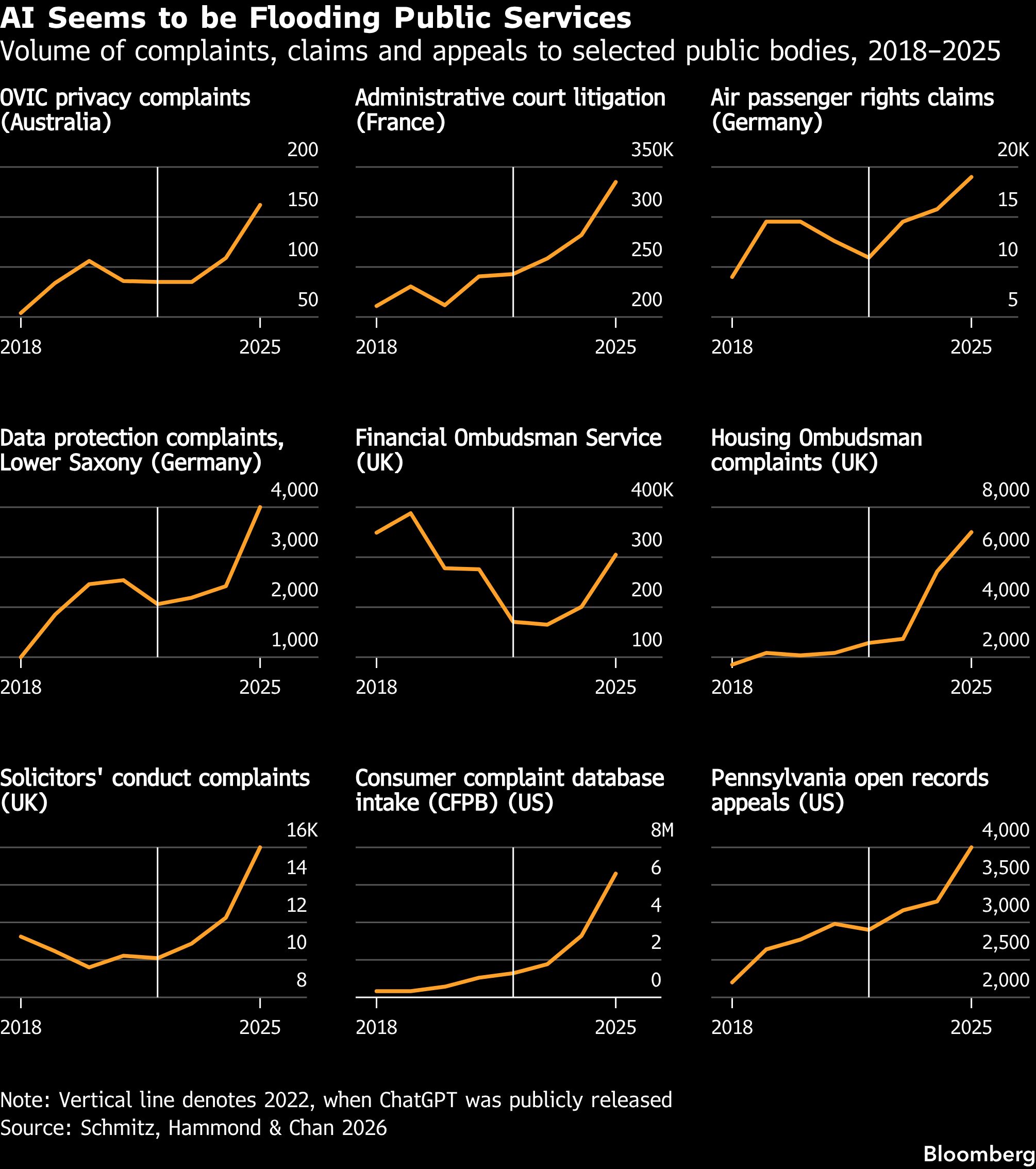
That caution matters because AI can increase the volume of work. A study published in August by researchers including Chris Schmitz of Berlin’s Hertie School recorded 84 cases in 11 countries of what they call “agentic flooding”: an AI-enabled rise in complaints, court claims and other requests. Many involved chatbots producing polished, legal-sounding submissions. The researchers warn that quick fixes such as fees could also keep people with valid claims from being heard.

Even when software can process more requests, some duties carry decisions that people may expect a person to make. Proposals in Britain to reduce the use of jury trials have already faced strong opposition; the prospect of an AI judge shows why technical capability alone won’t determine what public services automate.
Trust, staffing and costs shape the outcome
ING Chief Economist Marieke Blom questioned whether the Dutch plan can meet its targets. Earlier reductions in civil service headcount have been followed by renewed hiring, she said. AI could reduce staffing needs, but it may also create work if people use AI agents to send institutions a surge of complaints.
Control over the technology is another constraint. Few leading AI models are built in Europe, and policymakers may hesitate to hand large parts of civil service work to products from the United States or China. The Dutch say they will favor suppliers from the Netherlands and Europe. In Britain, reliance on US cloud providers has drawn concern, while a £330 million data contract with Palantir for the health service has faced growing questions about value and data security.
“The thing the British public really doesn’t like is their private sensitive data, particularly their healthcare data, going to foreign billionaires,” Narayan said last month. Governments are also trying to reassure staff and the public that AI won’t bring widespread job cuts, while encouraging adoption. Narayan has described technology development and use as needing to align with Labour values.
Workforce resistance could further complicate plans. Civil servants are often highly unionized. Across high-income countries analyzed by Bloomberg, civil service union membership averaged more than twice the rate for the workforce overall. More than a quarter of US federal employees belong to a union, compared with a tenth of all workers; in South Korea, the figures are two-thirds and 13%.
There’s also skepticism about whether AI is always the real reason behind job cuts. Labour MP Anneliese Dodds told Bloomberg that some companies were making “performative mentions of AI as a reason for redundancy,” even when cuts may already have been planned. For the Dutch plan, the measure to watch is whether AI changes how work gets done—and whether services can absorb new demand—alongside the headline headcount target.